Ontario Porta Pros can get portable toilets, holding tanks and handwashing stations on the ground fast when a flood, fire or utility outage cuts off normal plumbing. Standard unit daily rates run 100 to 350 dollars, and we stage equipment so Ontario households and response crews aren't waiting on service they need now.
Speed depends on what's already staged and what the site needs. A single standard porta potty rental can go out same day in most cases, while a coordinated response with temporary fencing, light towers and multiple restroom units takes more lead time to route trucks and confirm access. A roll-off delivery needs about 60 feet of straight clearance behind the truck, and that matters more than usual when debris, downed lines or flood water narrow the approach. We ask about site access up front so the truck isn't turned around at the curb.
For households on well water or septic systems knocked out by storm damage, a holding tank rental can bridge the gap until repairs happen. Shelters and staging areas often need more than toilets. Handwashing station rental units pair with restrooms to cover basic hygiene, and 29 CFR 1910.141(d)(2) requires soap and towels or a hand-drying device at wash stations, not just sanitizer. That rule applies whether the site is a construction yard or a temporary shelter, and it's an easy thing to overlook when everyone's focused on the bigger emergency. We also stock portable sink rental units for kitchens and feeding operations set up during a response.
Distance matters for response time too. Crews working a disaster site near Eastvale, 6.8 miles south of Ontario, or out toward Jurupa Valley, 9.0 miles east, still fall inside our normal delivery radius, so staging doesn't add a meaningful delay.
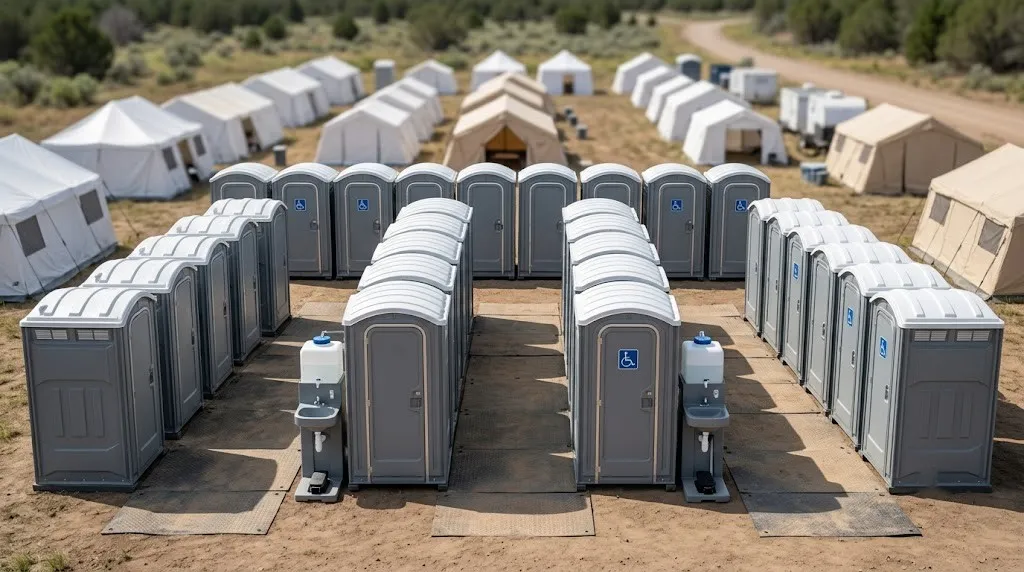
A shelter or staging site needs toilets sized to headcount, water, and a way to wash hands, and the ratios don't change just because it's an emergency. OSHA 1926.51(c)(1) sets construction-site toilet ratios at one facility for 20 workers or fewer, one toilet and one urinal per 40 from 20 up, and one per 50 at 200 or more workers, and that same math is a reasonable planning baseline for a relief operation with a similar headcount. OSHA 1926.51(a)(1) also calls for an adequate supply of potable water at any worksite, which applies directly when normal water service is down.
If the population served includes anyone who can't use a standard step-up unit, ADA Standards section 213.2 requires that at least 5 percent of a cluster of single-user units be accessible, and never fewer than one. Our ADA accessible porta potty units meet a 60 inch turning circle per ADA Standards 304.3.1 and a 32 inch minimum door opening under section 404.2.3, so wheelchair users aren't left out of a hastily assembled shelter layout. For larger operations, an 8 stall restroom trailer or 4 stall restroom trailer covers more people per unit than scattered single toilets, which matters when space at a shelter site is tight. Debris cleanup crews working alongside the shelter often need a roll-off dumpster rental too, and OSHA 1926.25 requires scrap and debris to be cleared from work areas as part of basic housekeeping.
Don't forget power. A temporary power pole or light tower rental keeps a night shift running when the grid is still down, and GFCI protection under OSHA 1926.404(b)(1)(ii) matters more, not less, when extension cords are running across wet ground.
Septic backups are common after flooding, and Ontario Porta Pros handles both emergency pump-outs and interim holding tanks while a system dries out or gets repaired. Our emergency septic service responds when a tank has flooded or backed up, and septic day rates run 150 to 300 dollars depending on tank size and access. A typical residential septic tank is pumped every 3 to 5 years under normal conditions, but a flood event can force an unscheduled pump-out well outside that cycle, and waiting makes the mess worse. If the disaster hit a restaurant or commercial kitchen, grease trap pumping may also be overdue, since a grease interceptor needs pumping once fats, oils, grease and solids reach 25 percent of the liquid depth.
Households further from Ontario aren't left out. Crews working storm cleanup near Upland, 8.3 miles northwest, or Montclair, 7.4 miles northwest, fall within our normal service radius, and we can also route porta potty rental equipment out to those areas without a special trip charge structure. For agencies coordinating a multi-site response, our construction site services page covers the fuller equipment list, from fencing to storage.
It depends on headcount, and there's no flat number that fits every shelter. Use the how many porta potties do I need guide, which walks through OSHA 1926.51(c)(1) ratios by worker or occupant count, then call us with your expected population so we can confirm the count before delivery.
Yes, if the route is safe for a truck. We prioritize disaster calls, but a driver won't cross an active flood zone or a road blocked by fire crews. We coordinate timing with your on-site contact and reroute delivery as road conditions change, sometimes staging equipment nearby until access opens.
Yes. Hand sanitizer station rental units supplement wash stations, but they don't replace soap and water under 29 CFR 1910.141(d)(2). Most shelter and relief sites order both, since sanitizer alone doesn't meet the washing requirement when real handwashing facilities are called for.
We supply self-contained portable toilets and holding tanks that don't need a water hookup, plus handwashing stations with their own reservoirs. For power, a temporary power pole or generator-fed light tower keeps the site running independent of the grid.
Septic pump-outs run 150 to 300 dollars a day depending on tank size, access and how much water needs removing. Flood-related calls sometimes need more than one visit; see septic tank pumping cost for the fuller breakdown before you budget the response.
Yes. Ontario Porta Pros delivers disaster relief sanitation across Ontario and the surrounding metro, with same-day and next-day drop-off available on most orders.
Pricing depends on the unit and how long you need it. See our cost breakdown and request a free quote for an exact figure.
Standard rentals include scheduled service — a pump-out, a clean, a restock and fresh deodorizer. Busy or hot-weather sites can be serviced more often.
Call now or request a free quote — clean units, on-time delivery, transparent pricing.