A marathon or 10K in Ontario typically needs one standard unit per 200 to 300 runners at the start corral, plus extras near mile markers and the finish line. Ontario Porta Pros builds the count around your race map, your aid stations and your expected field size, not a flat guess.
Start with the field size, then spread units across the course, not just the start line. A standard unit runs $200 to $400 for an event booking, and races usually need a cluster at the start corral, a few pairs at aid stations, and a bigger bank at the finish where runners linger. OSHA 1926.51(c) sets construction toilet ratios by crew size, but race organizers generally lean on the same logic: more people, more fixtures, shorter lines. A 5K through a neighborhood in Ontario needs a lot less than a marathon looping past Eastvale, 6.8 miles south, or up toward Upland, 8.3 miles northwest. Check our guide on how many porta potties you need for a fuller breakdown by headcount. ADA Standards section 213.2 requires that at least 5 percent of any cluster of single-user units be accessible, never fewer than one, so if you're placing eight units at the finish, one needs to meet that spec. We stock ADA accessible units built to that standard, with a 60 inch turning circle inside per ADA 304.3.1. Don't forget water and handwashing at aid stations too; a handwashing station rental or a simple portable sink covers that without extra plumbing.
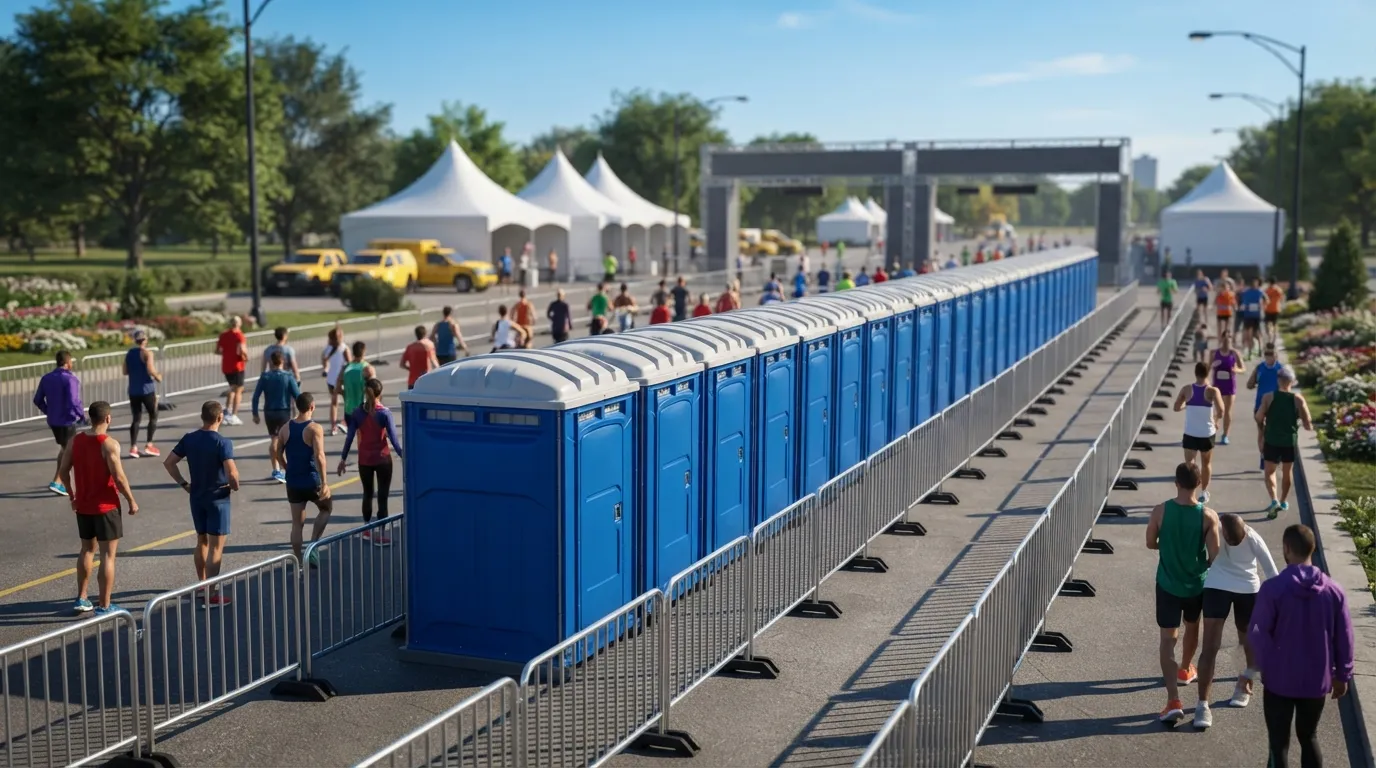
Placement matters more for races than for a static job site, because runners are moving and your restrooms aren't. Put units at the start corral early, stage a second wave near the halfway point, and load up the finish festival area where people wait for friends and results. A porta potty placement guide covers ground clearance and stable, level footing, which matters on grass infields at Ontario parks. ADA Standards 302.1 calls for stable, firm, slip-resistant surfaces, so a unit dropped on soft turf after rain needs decking or gravel underneath it. If your race also runs a finish line festival with a beer garden or food trucks, you'll want deluxe flushable units there instead of standard ones; runners and spectators notice the difference. Races that stage a lighting rig or timing tent overnight before the gun often need a generator or temporary power pole for chip-timing equipment and PA systems. Knowing how to brace a temporary power pole matters here: crews set a proper base plate, then run guy wires to fixed anchor points on at least three sides before runners start arriving, since race-morning crowds bump into anything left loose. If your event needs fencing to keep runners on-course near a road crossing, temporary fence rental or crowd control barrier rental handles that separately from restroom logistics.
Book restrooms as soon as your course map and expected field size are set, ideally 60 to 90 days out for anything drawing several hundred runners. Weekend races carry weekend pricing, and a standard unit rented for an event weekend runs $125 to $400 depending on unit count and how far Ontario Porta Pros has to haul equipment. Delivery trucks need roughly 60 feet of straight clearance to drop and pick up units at each staging point, so tell us if your course finish sits on a narrow street or inside a parking structure. For races that draw runners from Montclair, 7.4 miles northwest, or Jurupa Valley, 9.0 miles east, we coordinate multi-point delivery so units land at each aid station before the field spreads out. Bigger events sometimes need a full restroom trailer rental at the finish festival instead of a bank of standard units; a 4 stall restroom trailer handles heavy finish-line traffic better than a dozen standalone units spread thin. If your race includes an expo or packet pickup the day before, ask about event restroom rental packages that cover both days under one delivery fee.
| unit | weekend price |
|---|---|
| standard | $125 - $400 |
| ada | $199 - $300 |
| trailer | $900 - $3,000 |
Sixty to ninety days out is safest for races over 500 runners, since equipment and delivery slots fill fast on weekend mornings. Smaller local 5Ks in Ontario can often book two to three weeks ahead. Request a quote early if your date lands during a busy race season.
Yes. ADA Standards 213.2 requires at least one accessible unit per cluster, and never less than 5 percent of the total. Races with adaptive athlete divisions often need two or three spread across the course, not just at the finish.
Units get decked or graveled ahead of time on soft ground per placement guidance, and service crews stay on standby for extra cleanings. Check our porta potty in winter page for wet-weather placement notes that apply to rainy race mornings too.
Yes, and many races do exactly that, mixing a few units on the course with a bigger bank or a restroom trailer at the festival. Deluxe units work well here since spectators expect more than a bare-bones unit.
Runners handle water cups, gels and timing chips all day, so stations near aid points and the finish line matter. A handwashing station rental meets 29 CFR 1910.141(d)(2), which requires soap and towels, not sanitizer alone.
Yes. Ontario Porta Pros delivers marathon and race restrooms across Ontario and the surrounding metro, with same-day and next-day drop-off available on most orders.
Pricing depends on the unit and how long you need it. See our cost breakdown and request a free quote for an exact figure.
Standard rentals include scheduled service — a pump-out, a clean, a restock and fresh deodorizer. Busy or hot-weather sites can be serviced more often.
Call now or request a free quote — clean units, on-time delivery, transparent pricing.